
Your O-1A is valid for a maximum period of three years, ties you to the...

How to Obtain a Green Card in the U.S
A U.S. Green Card allows foreign nationals to live and work permanently in the United States under lawful permanent resident status. While it offers significant rights and long-term stability, obtaining a Green Card is a complex legal process governed by strict immigration laws and eligibility requirements.
There are several legal pathways to permanent residence, including family sponsorship, employment-based petitions, investment, and other specific categories. This guide outlines the main options to obtain a U.S. Green Card and explains why choosing the right legal strategy is essential before starting the application process.
Summary
What Is a Green Card?
Legal Definition of a Green Card
- Permanent Resident Status (Lawful Permanent Resident – LPR)
With a few limited exceptions, becoming a lawful permanent resident of the United States is a necessary prerequisite to the ultimate goal of many immigrants, which is to become a naturalized citizen. A lawful permanent resident of the United States may freely live, work and study in the United States, and is eligible to file petitions for permanent residence for certain family members, including spouses and unmarried children.
Lawful permanent residents are sometimes referred to as “green card holders” due to the green color that has historically been used for Lawful permanent resident cards.
- Difference between a Green Card and a temporary visa
Whereas a lawful permanent residence grants an individual the freedom to live, work and study where they choose, a temporary visa generally carries more restrictions, and are generally limited in duration. For example, a F visa for students requires that the foreign national attend school and make progress towards their degree program in order to maintain the validity of the visa.
Similarly, work visas (such as H-1b, L-1, E-2 or O-1 work visas), require the visa holder to work for a certain employer, or in some cases manage their own U.S. company, in order for the visa to remain valid.
Obligations of Green Card Holders
- Compliance with U.S. laws
Unlike U.S. citizens, lawful permanent residents are still eligible for deportation, if they commit certain serious crimes or acts. Additionally, they are subject to U.S. taxation laws, male are eligible to be drafted into the U.S. military.
- Residency requirements
In order to maintain permanent resident status, a foreign national is expected to spend the majority of their time in the United States. Prolonged period of time outside of the United States can cause the government to determine that the an individual has abandoned their permanent residence. A period of more than 6 months outside of the United States in a single trip will raise a rebuttable presumption of abandonment of permanent residence.
- Risk of abandonment or revocation
Main Ways to Obtain a Green Card
Green Card Through Family Sponsorship
Who Can Sponsor a Family Member?
- U.S. citizens
U.S. citizens have more options for sponsoring family members than lawful permanent residents. U.S. citizens can file family-based petitions for their spouses, children, parents and even siblings and fiancees.
Spouses, parents and unmarried children under 21 are considered to be “immediate relatives”, and unlike other categories, are not numerically limited by annual visa numbers. U.S. citizens can file family based petitions for married children, children over 21 and siblings, but the wait times for these categories are generally much longer. U.S. citizens can also file petitions for their fiancees, through the form I-129F.
- Lawful permanent residents
Lawful permanent residents may sponsor their spouses and unmarried children.
Eligible Family Members
- Spouse
Both U.S. citizens and lawful permanent residents may petition for their spouses. However, issuance of permanent residence for spouses of lawful permanent residents is subject to annual availability of a limited number of visas, whereas the permanent residence for spouses of U.S. citizens is always an available option, there are no numerical limitations.
Additionally, the spouses of U.S. citizens can be approved despite certain violations of U.S. immigration laws which would make most other applicants ineligible.
- Children
U.S. citizens may petition for unmarried children under 21 as immediate relatives (meaning a visa is always available). U.S. citizens may also petition for unmarried children over 21, and married children of any age, though these categories generally have longer wait times, and are subject to annual numerical limits.
Lawful permanent residents may petition for unmarried children under 2 (category F2A), as well unmarried children of any age (category F2B). The wait times for unmarried children over 21 is significantly longer.
- Parents
U.S. citizens over the age of 21 may file a family-based petition for their parents. Parents are considered immediate relatives of the U.S. citizen, and can be approved despite certain past immigration violations.
- Siblings
U.S. citizens may file a family based petition for their siblings, though the wait times are extremely long.
Priority Categories and Waiting Times
- Immediate relatives vs preference categories
There is a key distinction between two categories of family-based petitions, “immediate relatives” and “preference category” relatives.
Immediate relatives include the spouse, parents and unmarried children under 21 of U.S. citizens.
Almost all other family based petitions fall under the “preference relative” category. This includes, unmarried children over 21 of U.S. citizens (category F1), married children of U.S. citizen (category F3), and siblings of U.S. citizens (category F4). Spouses and unmarried children under 21 of lawful permanent residences (category F2A) and unmarried sons and daughters of lawful permanent residents over age 21 (category F2B) also qualify as preference relatives.
One of the big differences between immediate relatives and preference category relatives the ability to include additional derivative family members. A preference category beneficiary generally is entitled to give derivative permanent residence to their spouse and unmarried children under 21, whereas a petition for an immediate relative is only for the direct beneficiary of the petition. So for example, if a U.S. citizen wishes to file for both of their parent (which are “immediate relatives), the U.S. citizen would need to file two separate petitions, whereas is a U.S. citizen wishes to file a petition for their sibling (which are classified as “preference category” relatives), the U.S. citizen would file just one petition in the same of their sibling, and this would entitle the sibling to also include their spouse and children.
- Visa availability and quotas
One of the biggest advantages of being an immediate relative of a U .S. citizen is that there are no annual numerical limits to the number of visas that can be issued. This contrasts with the preference categories, which often have wait times of several years, even after the petition to establish the family relationship has been approved.
Green Card Through Employment
Some of the most common Employment-Based Categories
- EB-1A: Extraordinary Ability
The EB-1A extraordinary ability visa is reserved for individuals in any field who have sustained national or international acclaim, and who have reached the very top of their field. There are 10 possible requirements, and the foreign national must demonstrate that they qualify for at least 3 of the 10.
The type of evidence that a foreign national can present to demonstrate that they are “extraordinary” as defined by the U.S. government can include, among other evidence: articles published about the foreign national and their work in the field in major media, proof of having won nationally or internationally recognized prizes, a very high salary compared to others working in the same profession, authorship of scholarly articles, or having played a leading or critical role in distinguished, well known or famous organizations.
- EB-2 / National Interest Waiver (NIW)
The EB-2 National Interest Waiver is a visa that allows a foreign national to bypass the job offer and labor certification requirement, which is normally required for an EB-2 visa, if the foreign national can demonstrate, among other requirements, that they have a proposed professional endeavor in the United States that is of national importance, and that they are well positioned to advance said endeavor.
Though historically, individuals in a wide variety of fields have qualified for the EB-2 National Interest Waiver, it has become much more difficult to qualify in recent years. Generally speaking, individuals who work in areas of science, technology, engineering and mathematics, especially those with advanced degrees, publications, leadership roles, or individuals who led major projects in these areas, will have the strongest profiles, with their past work serving to illustrate the type of positive national impact that they could have in the future, if allowed to live and work in the United States permanently.
- EB-2 advanced degree professionals, and individuals with exceptional ability, and EB-3 Skilled and Other Workers, with a labor certification
One of the most common way to qualify for permanent residence through an employment based immigration petition is through the EB-2 or EB-3 visas, with a labor certification. The labor certification process allows a U.S. employer to sponsor permanent residence for a foreign national through a good-faith job offer. However, the U.S. employer must first undergo a labor certification process, where they must first attempt to advertise the position to U.S. workers. Only if no U.S. workers are available, qualified and willing to accept position, can the U.S. employer thereafter offer the position to the foreign national, unless they also hire all of the qualified U.S. workers who apply.
Why Legal Strategy Matters in Employment-Based Cases
- Category selection and Risk Mitigation
There are sometimes multiple immigration options available, each with its own chance of success, costs, risks, benefits and timeline. Because U.S. immigration is generally a very slow process, it may not be evident that the wrong category was chosen until several years later when the case is denied, which can cause several hardship for the foreign national and their family. Therefore, it is absolutely critical to speak with an experienced attorney before starting the process, to ensure that the best immigration option is chosen at the very start of the process.
- Evidence and documentation
The evidence that must be presented is generally different for each type of visa. While evaluating the different available immigration options, an experienced attorney will carefully review each type of evidence that the foreign national and the U.S. employer are able to produce or provide, to ensure that they are ultimately able to qualify for the desired immigration benefit.
Step-by-Step Process to Obtain a Green Card
Step 1: Determine the Appropriate Green Card Category
- Legal eligibility assessment
The first step in someone immigration journey is to gather all of the relevant facts, and compare them against all application immigration benefits, in order to determine what options may ultimately be available. Sometimes there is only one option, sometimes there are many.
Immigration benefits, including visas, permanent residence, citizenship, work permits and other benefits, can be thought of as each having its own “checklist” of legal requirements. If the foreign national, and if applicable, their U.S. petitioner (family member, or petitioning company or organization), meet all of the requirements set out by law, then the applicant can qualify for an immigration benefit
- Common mistakes at this stage
In the initial stages of immigration planning, the most common mistake can include choosing the wrong immigration option, choosing the wrong method by which to apply (see consular processing vs adjustment of status section below), or inadvertently taking action which may negatively affect eligibility. A common example of this latter case when the child of a U.S. citizen or lawful permanent resident decides to get married before the age of 21, and before their parent has filed a petition on their behalf. In this case, the very act of getting married makes them ineligible for certain family-based immigration benefits, potentially lengthening their immigration journey by several years, or making them lose eligibility entirely.
Due to long processing times, the consequences of a mistake made early in the process may not become apparent for many months, or even years, which underscores the importance of a detail initial analysis and long-term immigration planning. Additionally, there are sometimes several different immigration paths which lead to the same outcome, but which may have radically different costs and processing times (for example, filing of a petition for a foreign fiancee vs getting married and filing a petition for a spouse).
Step 2: Filing the Immigration Petition
- Required forms
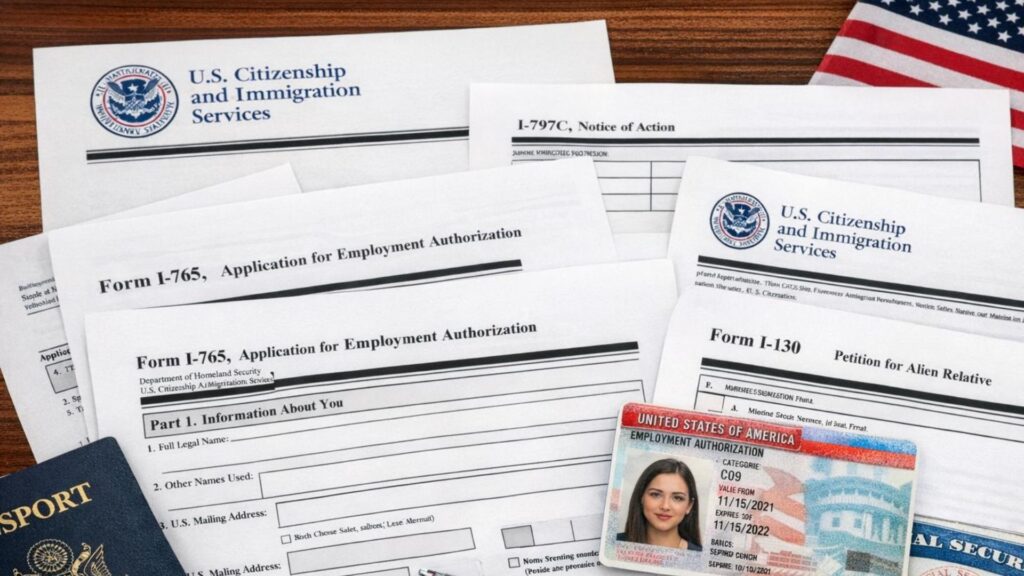
The immigration forms vary depending on the type of immigration benefit being sought, and can even vary depending on the method by which the foreign national requests that the government approve their permanent residence (adjustment of status within the country vs consular processing through a U.S. embassy). Most family-based petitions are generally filed through the form I-130, though certain relatives such as fiancees and widowed spouses will use a different form.
In the case of most employment-based immigrant petitions, a form I-140 is filed by the employer, or in certain cases, by the foreign national themselves if the immigrant visa category permits self-petitions. This latter category is limited to the EB-2 National Interest Waiver and EB-1A extraordinary ability categories.
- Supporting documentation
The supporting documentation will vary depending on the benefit sought. For family-based petitions, the petitioner and foreign national must generally present proof of a family relationship (birth certificate, marriage certificate, adoption certificate, etc.) and in many situations, an affidavit of support, demonstrating that the U.S. citizen or lawful permanent resident relative, or a substitute sponsor will assume financial responsibility for the immigrant, if they choose to accept certain government benefits.
Employment-based immigrant visa categories will generally require proof that the foreign national has the necessary qualifications for the job offered as part of the petition, as well as diverse employer-specific requirements that differ with each visa.
Step 3: Consular Processing or Adjustment of Status
- Differences between the two processes
Procedurally, a foreign national can obtain permanent residence through two avenues: consular processing through a U.S. embassy or consulate, or through adjustment of status within the U.S. through the United States Citizenship and Immigration Services (USCIS).
Generally speaking, unless the foreign national is already legally in the United States on a temporary visa, or some other form of temporary legal status, consular processing is the less risky and less restrictive of the two options. It is important to note that entering the United States with the preconceived intent to file for an adjustment of status (especially if the foreign national enters with a B tourist visa, or a short term F student visa), can be construed by the U.S. government as a fraudulent entry (a “misrepresentation”) and in the worst case scenario, can lead to a permanent ban from the United States. Therefore, no individual should file for adjustment of status without first consulting with an attorney, to ensure that the adjustment of status is done in a manner which does not put the applicant’s eligibility at risk.
Adjustment of status has the advantage of allowing the foreign national to apply from within the United States, but it carries two important restrictions. The first is that, with limited exceptions, an individual cannot engage in employment while the petition to adjust status is pending, until a work permit is issued, unless the individual already has some other form of work authorization (such as a work visa). The second major restriction is that the foreign national cannot travel until their travel permit, referred to an as “advanced parole”, is issued. Should the individual who has filed for adjustment of status travel before their advanced parole is issued, their petition to adjust status will be considered abandoned, requiring them to potentially remain abroad for several years while their case is transferred to a U.S. embassy or consulate. Foreign nationals who have filed for adjustment of status, but who have with H-1b or L visas (as well as their derivative relatives) are the only individuals who are exempt from the requirement of first seeking advanced parole before travel, these individuals can travel with their H or L visas without an advanced parole, without abandoning their petitions to adjust status.
The process of consular processing, allows an individual to obtain permanent residence through a U.S. embassy or consulate. This is the ideal choice for individuals who are already outside of the United States, and is also used by many individuals who are legally within the United States, in certain circumstances. For example, individuals who are legally in the United States, but have an urgent need to travel abroad regularly (business commitments, sick family members, etc.) may not be able to wait for an advanced parole to be issued, and therefore should obtain permanent residence through consular processing. Procedurally, consular processing has 3 main steps.
Greatly simplified, these steps are:
- File a petition with USCIS, obtain an approval
- USCIS sends the approved petition to the National Visa Center (NVC), which collects information, biographic documents, proof of family ties of the derivative applicants, police reports and other relevant documentation
- The NVC sends the approved petition to the relevant U.S. embassy or consulate, which then schedules the foreign national’s immigrant visa interview. Following the interview, the foreign national turns in their passport, and it is returned some days later with the immigrant visa affixed within, with the foreign national may then present at a U.S. point-of-entry, to enter the country as a permanent resident.Upon receiving the immigrant visa, the foreign national has 6 months to fly to the U.S. and activate their permanent residence, allowing them to choose a date to move which best suits their needs, as well as the needs of their employer (if it is an employment based process).
Step 4: Interview and Final Decision
Processing Times, Costs, and Key Factors
Average Processing Times by Category, and Factors That Can Delay or Complicate a Case
The average processing times vary by category, and even within each step of each category, and the processing times are always in flux. Factors which affect processing times can include the number of applicants, the choice of whether or not to pay a premium processing fee, existing backlogs at USCIS or the Department of State, country conditions in the country where the relevant embassy is located, decision by the U.S. executive branch, and the individual circumstances of the applicant, and the applicant’s nationality, among many other factors.
That said, one one can look at the Department of State’s visa bulletin, published monthly (see this URL: https://travel.state.gov/content/travel/en/legal/visa-law0/visa-bulletin.html) , which has two charts, the dates of fling chart, and the final action dates chart. The final action dates chart shows which groups of applicants are having their immigrant visas issued, taking into account nationality, immigrant visa category and application date. On one end of the spectrum, if a category shows “C” (for “current”), this means that individuals who apply under this category and have their petitions ultimately approved can be issued permanent residence right away, and may often have a green card in hand in around a year. On the other end of the spectrum, some categories have a wait time of more than 10 years.
Government Fees and Legal Costs
Government filing fees are constantly changing, and also vary depending on such factors as whether the petitioner files a paper application, or files online, and whether or not they decide to pay for premium processing services to guarantee a faster response from USCIS.
To give a general idea, the fees for the form I-140 (the most common USCIS immigration form for employment-based petitions), range from an absolute lowest fee of $665 (this would before a non-profit using regular processing), to the highest possible total fee of $4,280 (this would be for a for-profit company of over 25 employees, utilizing paper filing, opting to pay the premium processing fee).
U.S. employers undergoing the labor certification process would also be required to pay fees requirement and advertising fees, which would depend entirely on market conditions.
Legal fees can range from $4,000 for a very simple petition to over $15,000 for a complex one.
Testimonials
Why Work With an Immigration Attorney?
Complexity of U.S. Immigration Law
"With only a small degree of hyperbole, the immigration laws have been termed 'second only to the Internal Revenue Code in complexity.' A lawyer is often the only person who could thread the labyrinth."
Judge Judge John Noonan, a U.S. federal circuit court judge once famously stated
Immigration law requires a legal practitioner to be familiar with the Immigration and Nationality Act, the relevant portions of the Code of Federal Regulations, the norms and practices of many federal government agencies (USCIS, ICE, EOIR, CBP, DoS, etc.) and many other sources of law. It is a field so vast that most immigration lawyers tend to specialize in specific, niche areas of immigration law, relatively few practitioners will practice every form of immigration law.
Additionally, the field is constantly changing and evolving, and only a professional who is actively involves in the field in a daily basis can be expected to keep abreast of all of the changes that regularly take place.
Our Latest Blog Posts

H-1B Visa (2026): The Complete Guide to Working in the United States
Learn everything about the H-1B visa 2025: eligibility, costs, process, and legal support for professionals...

U.S. Work Visa: Types, Costs, and Procedures
Discover the costs, timelines, and steps for a U.S. work visa in 2025. Visa types,...